Showing posts with label The Iraq War. Show all posts

Thursday, July 17, 2008

Obama Iraq Documentary

While I suspect that this video ultimately comes from John McCain.com, I will give my formal H/T to the folks at Stuck on Stupid.

Gentle reader, please click on the link above to find out the real deal on how Barack Obama's positions on the Iraq War have shifted to suit the contingency of the moment. To be sure, this man is not now and never will be fit to lead this nation, nor serve as a Commander-in-Chief to the brave men and women of the armed forces.

Friday, March 28, 2008

The Space Between

In the advent of a blessed new arrival in my household, one of the few indulgences I have allowed myself lately is a few hands of poker with friends from my neighborhood. Instead of being a good little blogger and publishing a new post, I recently spent a night with seven other middle-class strivers while trying to keep enough of my own money to make this month's mortgage. Despite nearly all of them being card carrying members of ALPA (and my being the lone conservative skunk at the party), a good time was had by all.

Although there were some verbal nudges and pokes going around the table in between hands, it was during the apres-poker drive home where the liberal fur started flying. As I was the sober one - all the better to drive home safely should my crumb cruncher-to-be wish to untimely rip itself from the womb - I DD'ed while my two of my inebriated cohorts lectured me on the various outrages of the Bush administration vis-a-vis foreign policy.

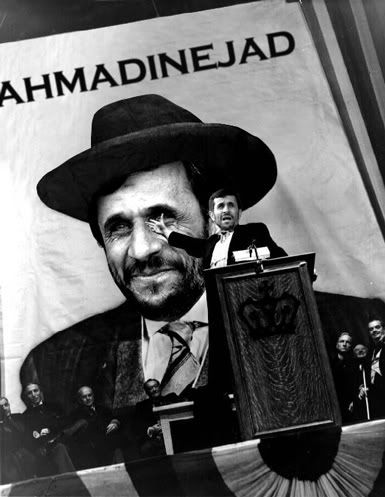
I was assured that, if only Bush & Co. would consent to talk to the likes of Mahmoud Ahmadinejad, Kim Jong-IL and whichever Castro brother is in charge this week, the clouds would be parted by beams of heavenly light, and peace would reign throughout the world. The lateness of the hour yesterday lends itself to the fuzziness of my recollection today, so I will not attempt to recount the entire conversation. Suffice it to say that while my friends agreed that Iran and Korea are "bad actors," they concluded that it was the fault of George W. Bush that we are (allegedly) the object of international opprobrium at present.

The notion that it is better to negotiate with the most irredeemable reprobates is hardly singular. Indeed, at one time or another, it has propelled the campaigns of both Democrats and Republicans (as discussed elsewhere.) That these same personalities can hardly bring themselves to extend a similar forbearance to a sitting president is the only remarkable element in this narrative, they being more ready to substitute inchoate raging for coherent and dispassionate reasoning about Bush's foreign policy successes and foibles. (A good measure of the degree of a person's progressivism quotient is to measure the time interval between a casual mention of George Bush and their responding with either "impeach," "worst president ever" or "war criminal.")

Liberals of the ilk of my poker buddies claim that the Iraq War remains an unremitting disaster, with evermore thousands of lives and billions in treasure summarily flushed into a Mesopotamian rat hole. They commend immediate withdrawal to our attention, even as they recommended interminable negotiations and U.N. junkets to Baghdad in lieu of war. As we might expect, they feel entirely nonplussed (or more accurately,
vindicated
) by a report from the Institute for Defense Analyses' Iraqi Perspectives Project claiming that there was "no 'smoking gun' (i.e., direct connection) between Saddam's Iraq and al Qaeda."

To be sure, the MSM - best exemplified by CNN - ran with this interpretation for all they were worth. But to say that "Saddam's Iraq" and al Qaeda were not linked in overarching purpose (the report describing it as wanting the West "out of Muslim lands") is to say that the Secretariats of Defense and the Interior are unlinked, even as they labor to uphold the same Constitution. It also bespeaks a refractoriness to the historical record.
While Hussein's vision of the Middle East as a pan-Arab state under his dominion was more modest than that of the Islamic caliphate espoused by Osama bin Laden, the report notes that Hussein "supported groups that either associated directly with al Qaeda... or that generally shared al Qaeda's stated goals and objectives." It also indicates that he "found common cause with terrorist groups who drew their inspiration from radical Islam," as evidenced by the regime's cooperation with both Abu Sayyaf and Hamas.

It would seem that this alone would be more than enough for our "allies" in Europe to have been more supportive of the invasion. But Saddam's outrages against civilization extend to
the use of top graduates of the Fedayeen Saddam training classes "for assignment to London, from there to be ready to conduct combat operations anywhere in Europe," such operations surely to include so-called "martyrdom" attacks. Hussein also maintained direct ties with groups such as Fatah, Force 17 and Egyptian Islamic Jihad (a predecessor to the current incarnation of al Qaeda.) Documents from the 1990s captured during current military operations indicate that the regime was also training Sudanese fighters inside Iraq.

How this accumulation is worthy of anything other than reprehension escapes me. Although this thought is hardly original, it occurs to me that people who are otherwise sober in their judgments of interactions between individuals completely take leave of their senses when evaluating the behavior of nations. My poker klatsch would hardly propose that a rape victim engage her attacker in order to understand the attacker's motivations, but they are quite ready to parley with an international rogue's gallery of thugs of more infamous reputation.

Such is of a piece with liberalism's essential nature. The depraved and criminally-intentioned of any stripe, and on any scale, are to be coddled as errant children in need of a hug, or at worst a "time-out." And no expedient is beyond the pale in defense of this type of imaginary thinking. So I am persuaded that for most on the Left - despite their education and life experiences - the longest distance between dogmatically held fiction and objective reality is the space between their ears.

Wednesday, March 19, 2008

To Liberate the Repressed

I spent the better part of last week steeling myself to help my wife deal with the death of her grandmother, who passed away after an extended bout with multiple physical ailments as well as dementia. Malinda Heaney let her light of Christian love shine for nearly 103 years, and I am a better man for having known her. As was evident at her homegoing yesterday, she inspired those she cared for to care for others out of the depths of their own souls.

As best as I am able to gather, the signal characteristic of her cohort was an appreciation for a certain modesty of manner, a singular ability to stifle thoughts, feelings or desires that might bring disrepute to oneself or one's family. Some of this plainness might be a product of life in small-town southern Minnesota, but I am persuaded that there was a generational esteem for a prudent reticence.

This gift of self-repression - the ability to silence the chattering id - is very much lost on the generations that succeeded Malinda's. Decades of the Left's efforts to erode any modicum of personal reserve have rendered us all a bit too in touch with our inner child. As progressives have seen fit to bastardize the motto of the U.S. Army Special Forces to their own purposes from De Oppresso Liber to De Represso Liber, any pretensions of unpretentiousness are seen now as either a vestigial organ to be excised or a social disease to be cured.


To our... well not shame really (lest our inflated sense of self be damaged by exposure to societal conventions), maybe to our momentary embarrassment - we can now recount recent instances when a bit of repression of ego might have been in order.
Even as we attempt to decipher whether "Client 9" or his consort will have the better post-scandal career, we are confronted by news of his successor's previous infidelities. All the while - in newspapers quite literally from New York to L.A. - we are told that fidelity is not even for the birds, but best modeled by parasitic worms. For my part, I have been as of yet unable to convince Malinda's granddaughter (or her son) of the unreality of marital fidelity. And so on my behalf, and that of married men elsewhere, a dollop of repression of a good many things is in order.

Would that the progressive political class could repress their own seemingly irrepressible psyches. Sen. Barack
"Houdini" Obama sought by power of speech to loose himself from the verbal baggage of his former pastor. (Apropos of not much, like Obama, I too was married at a ceremony officiated by Jeremiah Wright; I can only hope that Obama's vows took better than mine.) And while Obama attempts to hate the sin and love the sinner, he exposes the central dilemma of progressives, that of how to despise America sufficiently to maintain their liberal credentials without alienating the 49.99 percent of Americans who think that we live in a pretty decent country. Relying on hope over experience, I would recommend that Democratic politicians try to keep their "Hate America First" instincts repressed (at least until November 5th.)

Lest we be remiss, we will note on this 5th anniversary of the start of the Iraq War the clear distinction to be made between the fruit of repression and that of its fraternal twin oppression. As Iraqis attempt to emerge from the shadow of death - first at the hands of a brutal Baathist dictatorship and now by the devices of a cruel insurgency - freedom loving people give their first allegiance to the men and women who repress the weaknesses of their own flesh in order to repel the forces of entropy.

Beyond an instinctive fear of death, those who come as liberators must repress their own homesickness, loneliness, fatigue and even boredom that they might secure the blessings of liberty for those who have been thus far denied as much. And therein lies the difference. Doubtless, the yoke of oppression is best broken by the repression of fear of the oppressor. It is the avoidance of the equally necessary and inevitable conflict with dictators, tyrants and despots (an emerging specialty of the Left) that enables their evildoing.

Conversely (or perhaps similarly, I'm not sure), it was a love that passed understanding that enabled a woman frail and enfeebled by old age to repress her own preconceived notions in order to make room in her heart for a dark stranger who would try his best to love her granddaughter. As I said, I am made better by having known Malinda Heaney. Sadly, our world is made a bit worse by her absence from it. My prayer, and Malinda's as well I will presume, is that the love wherewith she cared for her family and friends may abide in us all.

Requiescat in pace.

Tuesday, January 22, 2008

Random Thoughts on Politics and Race

Like most everyone of a certain age (and a certain number of hard knocks), I know that every convergence is not necessarily harmonic. At the apex of our national celebration of the life and legacy of MLK, we bore witness to an intersection of events that included a former president being told to "chill," a black Democratic candidate getting "smacked down" for acknowledging the singular appeal of a white Republican president (even as said candidate has modeled his campaign on the Reagan revolution), and Democrats continuing to ready the moving vans for a precipitous retreat from Iraq.

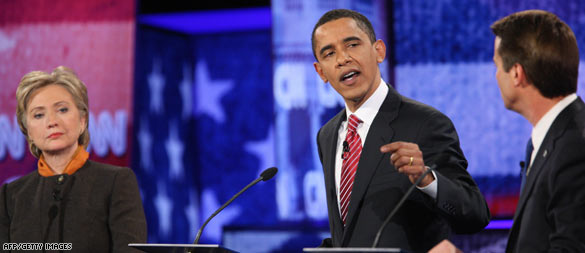
During last night's CNN/Congressional Black Caucus debate in South Carolina, Sen. Hillary Clinton condemned President Bush regarding his plans to maintain the stability established by our military in Iraq. By doing so, she ignores the contradictions inherent in her position. Sen. Clinton (and John Edwards) knowingly and willfully voted in support of the President's invasion of Iraq - even in the face of predictions from then-Army Chief of Staff, Eric Shinseki regarding the need for "several hundred thousand" troops as opposed to the approximately 150,000 that were deployed. When things began to unravel, Democrats then cited Gen. Shinseki's remarks in order to question the wisdom of a war that they initially advocated. Congressional Democrats then opposed the troop surge, and now the would-be Democrat nominees are all calling in unison for all military personnel to be withdrawn from Iraq.

If none of this makes sense, it shouldn't. Withdrawing from Iraq in order to "force" the Iraqi parliament to meet entirely arbitrary political benchmarks makes about as much sense as the U.S. leaving the Korean peninsula in order to "force" North and South Korea to come to their own political reconciliation. What also doesn't make sense is why progressives now choose to ignore one of their former poster children who said in a recent Washington Post op-ed that "whether we like it or not, Iraq is central" to the fight against Islamic extremism. Now that retired Gen. John Batiste seems to be on board with the Bush strategy for victory in Mesopotamia, Democrats choose to turn a deaf ear to his admonitions.

We cannot walk away from our strategic interests in the region. Iraq cannot become a staging ground for Islamic extremism or be dominated by other powers in the region, such as Iran and Syria. A premature or precipitous withdrawal from Iraq, without the requisite stability and security, is likely to cause the violence there - which has decreased substantially but is still present - to cascade into an even larger humanitarian crisis.
As for that overheated former president, House Majority Whip James Clyburn (D-SC) indeed suggested that Bill Clinton surely needs to "chill a little bit" on his attacks on Sen. Barack Obama. With Clinton attacking Obama on anything and everything, Obama would be forgiven for feeling besieged. And with CNN reporting "a huge shift among African-American Democrats from Clinton to Obama," the Clintons might be forgiven for their repeated hits below the political belt.

What is not forgivable, at least to the rabid Democrat base, is the idea that Barack Obama would even appear to bestow begrudging praise or even acknowledgment upon Ronald Reagan. How interesting is it that the "transracial" candidate is being verbally assaulted by his fellow liberal progressives for the unforgivable sin of being obliquely complimentary to a white Republican. This from the party that intends to unite Americans such that we can all move beyond political partisanship.

To be sure, none of this surprises. Nor am I entirely surprised that all of this occurred on or about MLK Day. Democrats flagellate themselves in a vain effort to appear slavishly devoted to their African American supplicants. All the while, their actions vis-a-vis race bespeak a barely disguised contempt. It will not be enough for blacks to simply vote for a new type of Democrat. In order to move closer to the fulfillment of Dr. King's aspirations, all of us - black, white and otherwise - will need to recommit to the equally just and achievable goal of equality of opportunity as opposed to an unattainable equality of result.

Wednesday, January 16, 2008

Lies, damn lies and statistics

The success of the military surge in Iraq aside, little about the war has been more controversial than the subject of "excess" civilian casualties. Understandably, collecting reliable data in the middle of an insurgency while the population teeters on the edge of civil war presents a less than ideal scenario for data collection. Nevertheless, more than a few methodologies have been used to attempt to get to a reasonably accurate number of Iraqi deaths.

The anti-war group Iraq Body Count (IBC) collects
data on civilian deaths "from cross-checked media reports, hospital, morgue, NGO and official figures to produce a credible record of known deaths and incidents." IBC's latest tally of deaths attributable to the war ranges between 80,621 and 88,044
as of December 14, 2007.

A second method allowed for extrapolation of civilian deaths by way of population surveys conducted in specific areas of Iraq. The estimate of casualties derived by this technique - 655,000 deaths between January 2002 and July 2006 - was presented in a
study published in The Lancet. Predictably, there was considerable back and forth between those who supported the conclusions of the study and those who rejected them out of hand.

A result of this magnitude would seem dubious on its face, as it is higher than figures resulting from comparable analyses by a factor of twelve (see graph). The timing of the publication was also curious, as it was released three weeks prior to the 2006 mid-term election. But the figure sunk into the collective consciousness of those who opposed both the war and the Bush administration more generally. (It was recently cited in a Washington Post op-ed by George McGovern.)

Academics and journalists have expended considerable effort to debunk the results of the Lancet study since its publication. A National Journal article raised significant questions about both the study's methodology and the objectivity of the authors.

Skeptical commentators have highlighted questionable assumptions, implausible data, and ideological leanings among the authors, Gilbert Burnham, Riyadh Lafta, and Les Roberts.

[National Journal] has identified potential problems with the research that fall under three broad headings: 1) possible flaws in the design and execution of the study; 2) a lack of transparency in the data, which has raised suspicions of fraud; and 3) political preferences held by the authors and the funders, which include George Soros's Open Society Institute.

National Journal reports that some of the same authors did a preliminary study - also published in The Lancet - utilizing a similar methodology. (Perhaps not coincidentally, it was published just before the 2004 presidential election.) That article concluded that there were a minimum of 98,000 "excess" Iraqi deaths. But National Journal goes on to note that "[p]erhaps because that estimate contrasted sharply with the observations of embedded reporters, human-rights activists, and others on the ground in Iraq, the media gave it limited coverage." The problems with the original research were immediately evident to the unbiased observer.
In Falluja, Lafta recorded 52 deaths in 29 households, which amounted to 71 percent of the violent deaths recorded by the first Lancet survey. If representative, Lafta's sample translated into 50,000 to 70,000 dead in Falluja by September 2004 -- two months before the start of the second major American military operation to restore order. Falluja's prewar population was estimated to be 250,000, although U.S. officials said that the vast majority of residents had fled before the battles began. Lafta's Falluja death estimate was so far off the chart that his colleagues dropped it from the study, the authors said. (Emphasis added.)
By the time the second study was presented, circumstances on the ground in Iraq were such that public skepticism was universally reserved for proponents of continued military action.
Even though the second study was even further out of line with other sources' estimates than the first, it got tremendous attention -- probably because its findings fit an emerging narrative: Iraq was a horrific mess. The February 2006 bombing of Samarra's Golden Mosque, in particular, had sent the country spiraling toward sectarian warfare. (Emphasis added.)
Media sensationalism notwithstanding, it does appear that the skeptics will carry the day, as the study authors "have declined to provide the surveyors' reports and forms that might bolster confidence in their findings." The Lancet results are also at variance with data recently presented in the New England Journal of Medicine that estimate the number of violent deaths in Iraq
between March 2003 and June 2006 to be 151,000.

To be sure, the timing of
both articles' publication can also be called into question.
Soros is not the only person associated with the Lancet studies who had one eye on the data and the other on the U.S. political calendar. In 2004, Roberts conceded that he opposed the Iraq invasion from the outset, and - in a much more troubling admission - said that he had e-mailed the first study to The Lancet on September 30, 2004, "under the condition that it come out before the election." Burnham admitted that he set the same condition for Lancet II. "We wanted to get the survey out before the election, if at all possible," he said.
A well-worn aphorism posits that truth is the first casualty of war. It seems more than manifestly clear that anti-war bias animated this research from the very start. The fact that supposedly objective investigators would allow prejudices to color their research is troubling enough, but it does not entirely surprise. As discussed elsewhere, liberal bias has contaminated much of what passes for research in the area of climate change, all of it enabled and encouraged by an establishment that will brook no dissent from its orthodoxy. The insurmountable irony is that all of this comes from the very people who claim that conservatives are the ones who are "anti-science."

Tuesday, January 1, 2008

"He who has ears..."

Today as I hurtled home from visiting my mother and the in-laws in Christmas-Kwanzaa-NewYear's-land, my thoughts turned to America's bravest and best. I hoped that all was and remained as well as possible with our men and women in Iraq. As discussed elsewhere, last month was on pace to have the least casualties for U.S. servicemen since the start of the war. Sadly, 23 Americans lost their lives in in December 2007, with 14 deaths resulting from hostile fire and 9 deaths not related to combat. (H/T: icasualties.org)

Those who decry President Bush's surge strategy - and the Iraq War more generally - will correctly point out that 2007 was the deadliest year for U.S. troops in Iraq. Of the 3904 military personnel who have been killed, 901 (some 23 percent of the total) were killed last year alone.
To be sure, a bit of perspective is in order, as the human decency that commands our reverence for these fallen also demands that we acknowledge what their sacrifice has brought about.

I suspect it is not entirely surprising that - with 30,000 more troops operating at a higher optempo - there were more deaths overall last year. Even so, December 2007 had the second lowest number of casualties since March 2003 (bested only by February 2004 with 20 Americans killed in action.) Deaths of Iraqi civilians and security forces
stand at 543 for December, by far their lowest since January 2006. Lest we conclude that all of this was something of a fluke, we would do well to observe that all of these parameters have been steadily improving since June 2007, when the military surge began in earnest; surely this is beyond coincidence.

Moreover, al-Qaeda in Iraq has been reduced to a shadow of its former self, and
Muqtada al-Sadr's Shiite militias are not nearly as menacing as they were even a few months ago. Doubtless, there is much to be done and much about which to be concerned in Iraq. But the suggestion on the part of the Left that we must make a hasty withdrawal from a Mesopotamian "quagmire" is both ill-considered and reckless. Democrat suggestions that we "finish the job" in Afghanistan notwithstanding, if we do not win with honor in Iraq, we can scarcely hope to leverage events in our favor in places like Iran or Pakistan.

As this is the time of year to make predictions, I will indulge myself. I predict that in all of their bloviating about 2007 being the deadliest for American troops in Iraq, we will hear neither the
Netroots nor the congressional Democrats utter a mumbling word about the positive effects of the surge, particularly its impact on fatalities. For its part, the MSM has made only oblique references, with CNN and ABC News making the most direct commentary on the drop in U.S. deaths. The abiding tragedy surrounding the loss of each of these 3900 lives is that the labors and sacrifices of the brave are negated and derided as a matter of course by the craven.

Wednesday, December 26, 2007

You heard it here first!

We will surely continue to keep our servicemen in our prayers, particularly over the next few days. God willing, this month will have the lowest number of U.S. casualties since the beginning of the Iraq War. While one death is one too many, as of this writing there have been 19 deaths of American servicemen in December 2007, one less than the previous low of 20 deaths in February 2004. (H/T:icasualties.org)

Of course my highly refined sense of blogger's honor requires that I confess to the misleading nature of this post's title, as there is at least one other blog that broke this information before I did. (Massive H/T: QuickRob) Nevertheless, as sure as the
"Big Three" anchors are vacationing in their Aspen ski chalets, you will hear or see nothing about this in the MSM (as they would prefer to detail the woes of homeless veterans and Iraq War PTSD victims.)

In any event, the icasualties data demonstrate in an undeniable fashion that the surge is indeed working. Netroots activists, craven congressional Democrats and the rest of the Left's "axis of nitwits" notwithstanding, President Bush's current strategy in Iraq has succeeded beyond anyone's wildest expectations. Moreover, as Charles Krauthammer pointed out in a recent column, the surge has created the circumstances that allow for exactly the type of socio-economic progress that Iraq's Maliki government is "too sectarian and paralyzed" to engender by its own means.

Gen. David Petraeus's genius has been to adapt American strategy to capitalize on that development, encouraging the emergence of and allying ourselves with tribal and provincial leaders — without waiting for cosmic national deliverance from the newly constructed and still dysfunctional constitutional apparatus in Baghdad.

Al-Qaeda in Iraq is in disarray, the Sunni insurgency in decline, the Shiite militias quiescent, the capital city reviving. Are we now to reverse course and abandon all this because parliament cannot ratify the reconciliation already occurring on the ground?


Do the critics forget their own arguments about the irrelevance of formal political benchmarks? The transfer of power in 2004. The two elections in 2005. The ratification of the constitution. Those were all supposed to be turning points to pacify the country and bring stability — all blown to smithereens by the Samarra bombing in February 2006, which precipitated an orgy of sectarian violence and a descent into civil war.


So, just as we have learned this hard lesson of the disconnect between political benchmarks and real stability, the critics now claim the reverse — that benchmarks are what really count.

So liberals try to have it all three ways, proclaiming and denigrating the importance of political resolution as it suits them, all the while denying the need for regime change in Iraq in the first place - even as they made the case for exactly that prior to the invasion (as discussed elsewhere.)

It is more than fitting that this good news comes to us at Christmastime, when much of the world reflects on a peace that passes all understanding. Perhaps it is more than coincidence that the peace we are beginning to see in Iraq is beyond the comprehension of the anti-war Left.

Sunday, December 2, 2007

Do You See What I See?

Democrats in general - and presidential candidate John Edwards in particular - have made a great commotion over the idea that there are two Americas, one privileged and indifferent to the needs of those less fortunate and another America that barely ekes out an existence under ever-worsening economic conditions. The political meme of two societies has served Democrats in good stead for several election cycles, and there is no reason to expect that things will be any different going forward.

My sense is that the "two Americas" rhetoric maintains its shelf life because it resonates with everyone, Republicans and Democrats alike. We all suspect that there are two competing visions of such things as the creation of wealth, the distribution of scarce resources, the country's future and how we will defend that future from the existential threats we face at present.

Similarly, as it pertains to those threats, there are at least two visions of the utility of the Iraq War and the War on Terror. Democrats (even those who originally supported it) speak of their opposition to the War in Iraq, declaring that we should "finish the job in Afghanistan" (as if al Qaeda was discreetly confined to one nation in a backwater of the Middle East.)

These variances in vision play themselves out in recent findings from a Pew Research Center poll which addresses Americans' opinions about the Iraq War. The graph above was taken from the report, and describes perceptions of how the War in Iraq is progressing by party affiliation. It is clear from the Pew study that 48 percent of Americans feel the war is going very well or fairly well. This uptick in confidence coincides with the precipitous declines in violence against U.S. servicemen and Iraqi civilians since the military surge began.

Interestingly enough (if only in its timing), new
Rasmussen Reports poll data examining confidence in the War on Terror shows that 47 percent of Americans believe that the U.S. and its allies are winning against our enemies. And in what it describes as "just as significant a finding," only 24 percent of Americans think that the terrorists are winning. In addition, the sense of Americans vis-a-vis the future of the War on Terror has also improved perceptibly.

The Rasmussen Reports telephone survey also found that 35% of all American voters expect things to get better in Iraq over the next six months while 32% expect the situation to get worse. That’s the first time in years that a plurality has given a positive assessment on the situation in Iraq. The recent increase in optimism is substantial. Just four months ago, in July, 49% of American voters offered a pessimistic assessment of the situation in Iraq and only 23% expected things to get better.
For its part, much of the MSM (as ably represented by CBS' Bob Schieffer on today's "Face The Nation") refuses to and/or begrudgingly acknowledges any success in Iraq resulting from the surge. The New York Times prefers to focus on the rampant theft and bribery abounding in Baghdad (anyone in their Iraq bureau been to Newark lately?) while acknowledging with as many caveats and in as fine a print as possible that "security has improved." This is yet another example of the media hitching its wagon to progressives and their agenda, which reinforces the fact that the MSM is for all practical purposes of a liberal bent; unfortunately, such does not surprise.

What is a pleasant strain on our credulity is the fact that more Americans are ignoring the media barrage of bad news to see what is happening, both good and bad, in our efforts against terror in Iraq and elsewhere.

Tuesday, November 20, 2007

Moments of Truth

There are few things more laden with significance than marriage. As much is why the gay "rights" movement is atwitter over homosexuals having the option to marry (even though in at least one area where same-sex civil unions have been legal, precious few have availed themselves of the opportunity.) Issues of sexual orientation aside, marriage speaks to the optimism shared by the betrothed, as well as to that of the society in which they hope to spend their wedded bliss.

As I can personally attest, marriage also reveals fundamental truths about those who enter therein, particularly as the years progress. Every conflict, every disappointment, every sacrificial labor and every shared joy will serve to lay bear the true nature of the person underneath the veil or behind the cummerbund. And it is the prospect of seeing that truth, naked before us and the God to whom we made our vows, that makes marriage a situation not to be entered into ill-advisedly.

So perhaps just as one can discern improvement in Iraq from the truths surrounding the improving security situation in Baghdad (as reported by the New York Times with associated video and photos), or the fact t
hat weekly attacks in Iraq are falling to a level not seen since February 2006 (also from the NYT), one might be able to see as much from the upturn in Baghdad's wedding business (again, NYT.) The good news is that from any perspective, things in Iraq are steadily improving; we continue to confront and defeat al-Qaeda and their confederates and are denying them sanctuary from which to launch further attacks on America.

And so with all signs pointing to the wisdom of the Iraq War - and to a similar extent, that of the greater War on Terror - it is time now for liberals to marry themselves to the truth by way of contemplation of what we knew before that Tuesday in September, and what we know now. I offer the following for the Left's consideration:

1) If on the justification of the August 2001 PDB, President Bush decided to press for passage and implementation of the Patriot Act, would progressives have been supportive of such efforts?

2) If on a like basis, the President decided to preemptively and unilaterally attack Afghanistan in order to prevent 9/11, how would this have sat with the American Left?

3) Would liberals have supported warrantless wiretapping in order to prevent the 9/11 attacks? (And would the Times, the Washington Post and USAToday have leaked sensitive information about such programs?)

4) If we were able to capture Zacarias Moussaoui prior to 9/11, would liberals have supported waterboarding him in order to get information that would have thwarted the 9/11 hijackers?

5) If the U.S. were able to capture some or all of the hijackers, would liberals have agreed with confining them to Guantanamo Bay or a C.I.A. detention area overseas (or some Afghani equivalent of Abu Ghraib?)

And one more question for good measure...

6) If it were known that a Middle Eastern country were in violation of multiple U.N. resolutions (i.e.: resolutions 1747, 1737 and 1696), was responsible attacks on U.S. servicemen, was a state sponsor of regional terrorism and was in pursuit of nuclear technology, would the Left consider preemption against said country to be prudent and warranted?

We know liberals by the truths they reveal when they think no one is listening. They condemn President Bush for both failing to prevent 9/11 and for launching a preemptive war against Iraq in order to forestall future attacks. They would enter the United States into open-ended negotiations with countries that have shown neither the desire nor the ability to commit to peaceful resolution of conflict.

And soon, one of them will ask America to plight its troth to them and their schemes for the country. Acknowledging that any marriage is a difficult proposition at best, it is the wise bride who would cautiously scrutinize her would-be suitor. Life is too short to spend in an unhappy marriage.

Tuesday, October 16, 2007

Too Good No More

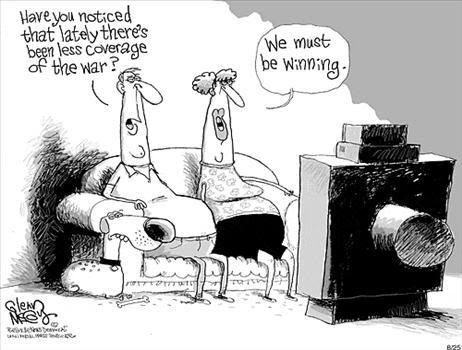
As noted elsewhere, an unfortunate truism vis-a-vis the Iraq War posits that any lull in coverage of the war is a sign that the U.S. is winning. For her part, Katie Couric did not mention the war one time in her broadcast tonight. In like fashion - with the exceptions of addressing Iraq by way of goings on in Turkey and pronouncing the names of the fallen - today's New York Times makes nary a mention of any effects of the surge that the impeccably botoxed Maureen Dowd recently judged as not working.

With so through a media blockade surrounding Iraq, it has fallen to the second tier of mainstream media to declare the military's successes. Yesterday's Washington Post more than filled the bill in detailing the "
devastating and perhaps irreversible blows" that al Qaeda in Iraq (AQI) has suffered at the hands of U.S. and Allied forces.

The deployment of more U.S. and Iraqi forces into AQI strongholds in Anbar province and the Baghdad area, as well as the recruitment of Sunni tribal fighters to combat AQI operatives in those locations, has helped to deprive the militants of a secure base of operations, U.S. military officials said. "They are less and less coordinated, more and more fragmented," Lt. Gen. Raymond T. Odierno, the second-ranking U.S. commander in Iraq, said recently. Describing frayed support structures and supply lines, Odierno estimated that the group's capabilities have been "degraded" by 60 to 70 percent since the beginning of the year.
To be sure, it is unknowable whether this progress against AQI will be sustained, but one thing remains self-evident. To the extent that we are able to degrade AQI's ability to advance its pogrom against the Iraqi people, we increase the likelihood of achieving a stable Iraq that can yet serve as an Arab ally in the heart of the Middle East. AQI is acutely aware of the importance of preventing such an eventuality from occurring, yet they are far from unique in that understanding.

There is one other man in the region who is mindful of the felicitous nature of an American defeat in Iraq. And liberal quibbling notwithstanding, the entire point of the Iraq War is of a piece with that of the larger Global War on Terror. By denying the enemies of America sanctuary and degrading their ability to destabilize friendly nations in the Levant, President Bush is clearly and directly advancing the end of enhanced national security.

Our enemies within and outside of Iraq are doubtless aware of the need for victory in Mesopotamia. And they are in no wise celebrating our successes thus far. Likewise, having neither the ability to talk up defeat in Iraq nor the decorum to share in our triumphs, the American Left has reduced itself to yammering on about supposed offenses by Rush Limbaugh and Ann Coulter - as well as imaginary right-wing assaults on liberal radio talk show hosts. All of this speaks to a frustrated impotence on the part of progressives.
Would that the apparent vexation of the NYT and CBS News (and much of the Democrat party) were not as great as that of AQI and Mahmoud Ahmadinejad.

Update: Here's video (H/T: Hot Air) of Washington Post and CNN reporters explaining why the good news coming out of Iraq should not be taken at face value.

Monday, October 15, 2007

The Truth Will Out

One of the sad consequences of being a conservative in the present age is that one must repeatedly endure seeing truth crushed to earth. We exist in a time where stupidity and cowardice - the two gravest threats to certitude - reign largely unchallenged. The idea, for example, that the 1-2 percent of CO2 that mankind puts into the atmosphere is the determining factor between global temperateness and planetary immolation is scientifically untenable. Yet it has taken such a hold on the collective imagination that supposedly prestigious awards can be given for attempting to convince much of the world's population that a 0.6 degree Celsius increase in the temperature of the earth's atmosphere over the last 100 years is more a cause for concern than terrorism, famine, poverty or disease.

So it is with the currently fashionable idea which posits that America's adventure in Iraq is an abject failure, and that all hope of remediation or salvage is lost. That such an idea was false from the moment it was expressed did not diminish its usefulness. It fit nicely with the thought - embraced by many in the suites of power in Europe, and by more than a few in progressive bastions here - that America deserves to lose in Iraq, that our chastening in the Middle East would ultimately be redemptive. This is still the favored line of belief for most of the Left, and virtually everything that liberal elites have done and said since 9/11 confirms that they still hold American defeat in Iraq as devoutly to be wished.

But it has become more difficult to express as much as of late. This is mainly because the good guys are no longer facing the prospect of defeat and retreat. Now comes more and more evidence that the Iraq War as most Americans understand it is a journalistic fiction. Thanks to Flopping Aces, we are privy to the observations of Victor Davis Hanson as he reports on his most recent trip to Iraq.

Almost all the Marines and Army units I visited from Ramadi to Taji to various hot spots in Baghdad and Diyala believe there has been a sudden shift in the pulse of battlefield. Sometimes without much warning thousands of once disgruntled Sunni have turned on al Qaeda, ceased resistance, and are flocking to join government security forces and begging the Americans to stop both al Qaeda and Shiite militias.
Dr. Hanson is as cautious as the military personnel that he interviewed during his week in Iraq, in as much as he readily acknowledges that military victories can be overwhelmed by political missteps. But even he is of the opinion that most of the officers and soldiers in Iraq "believed we could win - are winning."

But reporting on the good news from Mesopotamia is no longer confined to conservative outlets. Indeed, no less a liberal stronghold than the
Washington Post editorial page conceded yesterday that the situation in Iraq is much improved presently.
In September, Iraqi civilian deaths were down 52 percent from August and 77 percent from September 2006, according to the Web site icasualties.org. The Iraqi Health Ministry and the Associated Press reported similar results. U.S. soldiers killed in action numbered 43 -- down 43 percent from August and 64 percent from May, which had the highest monthly figure so far this year. The American combat death total was the lowest since July 2006 and was one of the five lowest monthly counts since the insurgency in Iraq took off in April 2004.

During the first 12 days of October the death rates of Iraqis and Americans fell still further. So far during the Muslim month of Ramadan, which began Sept. 13 and ends this weekend, 36 U.S. soldiers have been reported as killed in hostile actions. That is remarkable given that the surge has deployed more American troops in more dangerous places and that in the past al-Qaeda has staged major offensives during Ramadan. Last year, at least 97 American troops died in combat during Ramadan. Al-Qaeda tried to step up attacks this year, U.S. commanders say -- so far, with stunningly little success.
To be sure, the Post editorial was heavily caveatted, with the editors noting that present successes "could change quickly and tragically, of course." To their credit, the op-ed ends by acknowledging what has become overwhelmingly obvious. Namely, that "those in and outside of Congress who last month were assailing Gen. [David] Petraeus's credibility and insisting that there was no letup in Iraq's bloodshed were -- to put it simply -- wrong." Would that more of the Left were similarly disposed to concede that victory in Iraq is both feasible and desirable.

Monday, October 1, 2007

Worse Than War

It may be well-established in the minds of a majority of Americans - especially given our travails in the Middle East - that military conflict of any kind is an ultimately pointless effort that leads directly to more suffering than it could ever be worth. It is especially easy to draw such a conclusion in this present age of limited wars with nebulous objectives. The cause of nation-building in particular is especially susceptible to criticism from all corners, as those peoples who are in need of functioning central governments are most often also in need of a shared culture that will undergird and sustain a fledgling government.

And so, it is very easy to conclude that war is - to quote deceased soul singers and anti-war liberals - "not the answer."
To the thinking of the anti-war Left, there is little to be esteemed as infinitesimally - and avoided so assiduously - as war, and nothing is to be as devoutly wished as peace. Of course peace has a strange definition to this brand of progressive. As they would define it, peace is the absence of American involvement in armed conflict. America would not challenge tyranny, it would not act in defense of its allies, nor would it respond to terrorist acts against its own homeland.

We correctly gather as much from reading "The Peace Racket" by Bruce Bawer (as published in the City Journal.) Bawer describes an all-encompassing movement whose goals extend beyond the more easily embraceable idea of extracting American troops from the Middle East. This campaign is espoused by members of the House of Representatives, as well as by many in the capitals of Europe and the suites of the United Nations. Worse yet, it is well-ensconced in the halls of academia.

The Peace Racket's boundaries aren't easy to define. It embraces scores of "peace institutes" and "peace centers" in the U.S. and Europe, plus several hundred university peace studies programs. As Ian Harris, Larry Fisk, and Carol Rank point out in a sympathetic overview of these programs, it's hard to say exactly how many exist—partly because they often go by other labels, such as "security studies" and "human rights education"; partly because many "professors who infuse peace material into courses do not offer special courses with the title peace in them"; and finally because "several small liberal arts colleges offer an introductory course requirement to all incoming students which infuses peace and justice themes." Many primary and secondary schools also teach peace studies in some form.
The efforts of this apparatus are ostensibly directed to the end of establishing the premise that war is not the answer. But predictably, it sees America's military adventures as most problematic. Bawer quotes Johan Galtung, founder of the International Peace Research Institute and a leader in the international "peacist" movement, as saying that America is a "killer country" which is guilty of "neo-fascist state terrorism."

As Bawer notes, these peace strivers are most answerable when they suggest that freedom and the right to self-determination are appropriate offerings to be laid at the altar of peace. He describes
the former president of Costa Rica, Oscar Arias, as saying that America's "preoccupation with freedom versus tyranny as 'obsolete,' 'oversimplified,' and above all 'dangerous,' because it could lead to war."

But if the world must sacrifice freedom to dictators and totalitarians without dissent, let alone use of the force of arms in order to be at peace, how are those who would yield the former for the latter to be counted as worthy of either?
Indeed, if we do not judge the wanton and unavenged murder of innocents without justice or recompense (as is taking place in Myanmar presently) as worse than war itself, how then shall we be seen as moral actors? The peacists fall mute to the question of how - if we are content to live in the absence of hope or redemption in exchange for the promise of peace - we will avenge ourselves when more (in lives, treasure and human rights) is demanded of us?

They also are silent on the question of whether, if a nation could prevent the loss of even a single life by way of military action, such a nation would be morally just in failing to do so. To be sure, the calculus by which a free state would determine how many lives it should sacrifice to free others of another nation is difficult at best. But to yield to this difficulty and conclude than no loss of life elsewhere is worth even one American life is a most evil absolute, sought only by cowards. It simply cannot be better to be a pacifist and conclude that no amount of lost life on the part of the world's subjugated is worth less than the life of one American.
To persons of honor and decency, lives surrounded by such cowards is worse than war, or death itself.

Tuesday, September 11, 2007

Six Years Hence

With some understandable difficulty, I went to work today and followed my other routines when the workday was over. The terrorists did not win, not on my watch. Thankfully, the sky was clear and the weather was pleasant... all as it was on that other Tuesday.

We are six years hence from that other Tuesday, and being Americans, we have accrued to ourselves several luxuries in the interim. Senators and Congressmen can now indulge themselves in debating whether fighting terrorists in Iraq is contributing to winning the War on Terror. We hardly allowed for such opulent sophisms in years past; our enemies were our enemies back then, and we did not attempt to compartmentalize them into those that we should fight to the death versus those that we should negotiate with as "regional partners." Organized cadres of cry-babies and bed-wetters can besmirch and smear our truest heroes, and do so under the auspices of patriotic "dissent." This is yet another extravagance denied to our forebears.

But if there is one lavishness yet denied us, it is that of blissful ignorance. Dates on calendars notwithstanding, there will never, ever be a September 10th again. 9/11 split the history of our present age as was time by the birth of Christ. We will always look over our shoulders and watch the skies. Everything now gets at least a second look.

Would that such were the case in Septembers past. The sordid record of the failures and missteps of our pre-9/11 C.I.A. were recently summarized for all to review.

The [Joint Inquiry] concluded that, before 9/11, neither the US Government nor the [intelligence community] had a comprehensive strategy for combating al-Qa'ida. It charged that the Director of Central Intellignce (DCI) was either unwilling or unable to marshall the full range of IC resources necessary to combat the growing threat to the United States. The [C.I.A. Office of Inspector General] Team also found that the IC did not have a documented, comprehensive approach to al-Qa'ida and that the DCI did not use all of his authorities in leading the IC's strategic effort against [Osama bin Laden].
And while the report notes that George Tenet signed a December 1998 memorandum declaring "We are at war" against al-Qaeda, it goes on to condemn him and the Deputy Director of Central Intelligence (DDCI) for not "creating a documented, comprehensive plan to guide the counterterrorism effort at the Intelligence Community level." As the report clearly indicates, the comedy(?) of errors that led up to 9/11 can be laid at Tenet's feet; this was his C.I.A.

Of course if there is such a thing as historical precision, it would demand that we not be neglectful of the fact that this was also Bill Clinton's C.I.A. The man who professed to being "obsessed" with bin Laden seemed willing to do little to organize Central Intelligence such that OBL could be captured or killed. If anything, Clinton can be faulted for failing to do enough to bring bin Laden to justice; he surely remained obtuse to the warnings issued about bin Laden by the U.S. State Department. Indeed, his own words from a February 2002 speech are the strongest rebuttal to the idea that Clinton was concerned - let alone obsessed - with anything other than Monica Lewinsky's thong. (Audio from an interview with Bill on the matter, along with Hillary Clinton's more recent attempts at obfuscation, can be heard here. H/T: NewsMax.com)

Mr. bin Laden used to live in Sudan. He was expelled from Saudi Arabia in '91 and he went to the Sudan. We'd been hearing that the Sudanese wanted America to start dealing with them again. They released him. At the time, '96, he had committed no crime against America, so I did not bring him here because we had no basis on which to hold him, though we knew he wanted to commit crimes against America. So I pleaded with the Saudis to take him, 'cause they could have, but they thought it was a hot potato. They didn't and that's how he wound up in Afghanistan.

To be sure, Bill Clinton has repeatedly expressed "regret" for his failure to kill or capture bin Laden.

But even beyond Clinton's foibles vis-a-vis the nascent threat of Islamic terrorism, it should be noted that this was Michael Scheuer's C.I.A., as it was Paul Pillar's and Valarie Plame's. None of these now-vocal critics of the current administration could - by themselves or in collaboration with their peers - prevent or disrupt any of what occurred on September 11, 2001. Nor
(as discussed elsewhere) could they...
...preempt the April 1983 Embassy bombing in Beirut, the October 1983 bombing of the Marine barracks in Beirut, the attack on the World Trade Center in February of 1993, the suicide attack on the Khobar Towers in Saudi Arabia in June of 1996, the bombings of American Embassies in the East African cities of Dar es Salaam, Tanzania and Nairobi, Kenya in 1998, the attack on the USS Cole in Yemen in 2000 or the deadly attacks of September 11, 2001, all of which would seem to fall under [their] agency's purview.
Scheuer, Pillar and Plame - among many other standard-bearers of Bush hatred - would have us all believe that we were one Presidential Daily Briefing away from stopping the 9/11 attacks before they started. As the aforementioned C.I.A. mea culpa indicates, the truth is far more damning than any of them would let on. Pillar's concern over politicization of intelligence gathering should be the least of our concerns.

Most important of all, this was the C.I.A. that the Left built. Some of the same braying asses in the Senate - who on this very day dared to launch verbal assaults against David Petraeus and Ryan Crocker - were the very persons who emasculated the intelligence services (and never sought to remove a single brick from the much-discussed Janet Reno-Jamie Gorelick "wall" between law enforcement and intelligence.) And while they strutted and fretted before the cameras about "politicized intelligence" in the run-up to the Iraq War, they have become the politicizers, blithely attempting to de-link the Iraq War from the war on Terror.

And so in spite of ourselves, the terrorists did not win today. We are still Americans, and we still crave our indulgences. And American politicians being who they are still yield to their indulgence of choice. We would do well to remember that those with whom we struggle do not crave luxury for themselves. They seek only our deaths, as they made evident six years ago. Ignorance of the threat did not set us in good stead then, and arrogance or wishful thinking will bring us no closer to victory in the long war.

Monday, September 10, 2007

Thus Spake Petraeus

Even before the General and the Ambassador were able to begin their remarks to a joint session of the House Foreign Affairs and Armed Services Committees, CODEPINK, Cindy Sheehan and other anti-war protesters were at work, shouting "tell the truth" and "troops home now" (as reported by NPR News.) For its part, MoveOn.org was also up to its usual tricks, posting a full-page ad in today's New York Times intended to sway the public. But if the jeering mob hoped to get GEN David Petraeus off of his game, the tale of the (video)tape suggests that their mission was not accomplished.
As seen in Petraeus' written testimony, along with his slides, a corner is being turned in Iraq by way of the military surge. (Emphasis added.)

As a bottom line up front, the military objectives of the surge are, in large measure, being met. In recent months, in the face of tough enemies and the brutal summer heat of Iraq, Coalition and Iraqi Security Forces have achieved progress in the security arena. Though the improvements have been uneven across Iraq, the overall number of security incidents in Iraq has declined in 8 of the past 12 weeks, with the numbers of incidents in the last two weeks at the lowest levels seen since June 2006.

One reason for the decline in incidents is that Coalition and Iraqi forces have dealt significant blows to Al Qaeda-Iraq. Though Al Qaeda and its affiliates in Iraq remain dangerous, we have taken away a number of their sanctuaries and gained the initiative in many areas.
The one pleasant surprise from Petraeus' remarks was his conviction that the U.S. could "reduce our forces to the pre-surge level... without jeopardizing the security gains we have fought so hard to achieve."

As was expected, the progress evidenced in Ambassador Ryan Crocker's
report was less tangible; the Ambassador acknowledged "[t]here will be no single moment at which we can claim victory," adding, "any turning point will likely only be recognized in retrospect." Nevertheless, Crocker echoed Petraeus' sentiments in not supporting a precipitous withdrawal of forces from Iraq.
I cannot guarantee success in Iraq. I do believe, as I have described, that it is attainable. I am certain that abandoning or drastically curtailing our efforts will bring failure, and the consequences of such failure must be clearly understood. An Iraq that falls into chaos or civil war will mean massive human suffering - well beyond what has already occurred within Iraq's borders. It could well invite the intervention of regional states, all of which see their future connected to Iraq's in some fundamental way. Undoubtedly, Iraq would be a winner in this scenario, consolidating its influence over Iraqi resources and possibly territory. The Iranian President has already announced that Iran will fill any vacuum in Iraq. In such an environment, the gains made against al-Qa'ida and other extremists groups could easily evaporate and they could establish strongholds to be used as safehavens for regional and international operations. Our current course is hard. The alternatives are far worse.
Their efforts notwithstanding, there were two tragedies that overshadowed the testimonies of Petraeus and Crocker. The first was that men such as these who have excelled at every task their country has asked of them must be questioned - and have their credibility impugned - by lesser mortals whose sole qualification for employment was the ability to persuade a majority of their co-imbeciles to vote in their favor. Here is
video of Bob Wexler (D-FL) manning the ramparts of outrage in his lambasting of the General. Similarly, here is video of Loretta Sanchez (D-CA) questioning Crocker, while simultaneously slamming Petraeus.

Neither Wexler nor Sanchez will be bringing the cole slaw to the Mensa picnic, and it is beyond doubt that both the General and the Ambassador have more courage in a stray eyelash than Wexler, Sanchez or many of their fellow inquisitors have in their entire beings. We are a blessed nation for the likes of these patriots. Which gets me to the other tragedy, which is that still greater patriots will give their lives to defend the right of MoveOn, CODEPINK, et al. to embarrass themselves and befoul the People's House with their antics.

But as discussed elsewhere and , their most base purpose is hurt President Bush on a personal level. They wish to cause Bush embarrassment, if not outright pain, all for the purpose of validating their cowardice, their vanity and their stupidity. We can only hope that the resolve displayed by Crocker and Petraeus during today's hearing's will be matched by that of the President and his party. As Crocker himself put it,
our current course is indeed hard, and the alternatives to victory are far worse.

Sunday, September 9, 2007

Quotation Sparks

It has become axiomatic to suggest that liberals thrive on bad news (and whenever such news does not make itself apparent, they will distort good news to their purposes.) Nowhere is this more true than as it pertains to the Iraq War. The Left has repeated ad nauseum their assertion that the military surge in Iraq has failed, and - with less than 24 hours prior to General David Petraeus' testimony before Congress - have prepared themselves well in advance to discredit any encouraging news that he might reveal.

Doubtless, this effort did not just begin on the eve of his report; liberal bloggers have being laying in wait for Petraeus for some time now. They fully recognize what House Majority Whip James Clyburn pointed out in July (begrudging H/T to the Washington Post): namely, that if the Petraeus report was positive, that would constitute "a real big problem for us." So both the White House and the General have had to endure a blizzard of pre-report tarring and feathering. I share with you a small sampling of the most egregious examples. (Emphasis added as appropriate.)

Andrew Sullivan - July 18, 2007

If I were eager to maintain a semblance of military independence from the agenda of extremist, Republican partisans, I wouldn't go on the Hugh Hewitt show, would you? And yet Petraeus has done just that. I think such a decision to cater to one party's propaganda outlet renders Petraeus' military independence moot. I'll wait for the transcript. But Petraeus is either willing to be used by the Republican propaganda machine or he is part of the Republican propaganda machine. I'm beginning to suspect the latter. The only thing worse than a deeply politicized and partisan war is a deeply politicized and partisan commander. But we now know whose side Petraeus seems to be on: Cheney's. Expect spin, not truth, in September.
Daily Kos - August 15, 2007
So the White House will lie in the report it writes under Petraeus' byline, then "interpret" it on its own to justify anything it wants.

Let me predict the future:

The report: "Success!"

The interpretation: "Smashing success!"
AntiWar.com - August 22, 2007
If Gen. Petraeus is to present a genuine military report in September and not a "cooked" political document, he will have to buck the system. It should be fairly easy to judge whether he has done that or not, because if he has, the White House will howl. The gap between the reality in Iraq and the administration's rhetoric is so wide that it should show dramatically in any genuine military analysis. If it does not, and if the White House regards his report complacently, with just a few quibbles as part of the kabuki, then it amounts to nothing more than one of Napoleon's bulletins – from which we got the phrase, "to lie like a bulletin."
The American Prospect - August 22, 2007

Without many arguments left in the well, the White House will be hiding behind Petraeus, just as President Bush has been since the general took the job seven months ago. At first the administration didn't want Petraeus to publicly testify about his report, perhaps because it was concerned he might be a little too forthcoming about what is really happening in Iraq. But now the administration seems to have come to its senses, realizing that either Democrats will be cowed into deference by the blinding glare created by all those ribbons and the glittering aura of Petraeus' reputation, or they will question him harshly, at which point they can be accused of hating the troops and their saintly, infallible commander.

Don't interpret my sarcasm to mean that I think Gen. Petraeus is cut from the same dishonest cloth as the rest of the Bush administration. But by this time he is, most certainly, part of that administration. There has never been much dispute over the fact that throughout his career he has been a capable and accomplished, even brilliant, officer. But Petraeus was selected for his current job because of his willingness to support "the surge" (even today, saying it gives you that little shot of testosterone, the scent of victory wafting into your nose). And if he has any desire to keep his job, he will be sure to deliver the message the White House wants.

Democrats.com Unity - September 4, 2007

The war criminals and their enablers in Washington DC - both in the Corporate Congress and the Corporate Media - are waiting breathlessly for the Petraeus Cheney Report on the achievement of Bush's January benchmarks for Iraq to justify throwing yet another $200 billion into a living hell.

But if the preliminary Petraeus Cheney report is any indication, the final report will be full of lies.
Not to be outdone, Democrat politicians have expressed their own misgivings about General Petraeus' findings, with VOA News reporting that Sen. Diane Feinstein said earlier today that she doubts that Petraeus is an "independent evaluator" of what's happening in Iraq, and ABC News noting that Sen. Harry Reid says that the report "will pass through the White House spin machine, where facts are often ignored or twisted, and intelligence is cherry picked." More of the same can be found at the Washington Post's blog, and elsewhere.

To be sure, all of this overheated preamble is to be expected from the Left. The short story on them is that good news from Iraq - no matter how infinitesimal - cannot be countenanced. They seek a rapid withdrawal from Iraq entirely because they hate George W. Bush more than they care about America, or Iraq for that matter. Liberals want America to leave Iraq sooner rather than later entirely because they want the withdrawal - and the resulting loss of national prestige - to occur on Bush's watch, even as they see this as his war. They so want the President to ache with the grief of ignominy that all else fades from their view.

The question soon to be answered is whether Americans are prepared to trust those who are so recklessly single-minded with responsibility for our national security.